Briefing a Men's Facial Cleanser Formula: Six Decisions Before Sampling
A cleanser brief that arrives as "a men's face wash, 150 ml, good for all skin" sends the laboratory in six directions at once. Six decisions fix that: the skin target, the cleanser type, the texture, the pH and surfactant level, the fragrance, and the pack and fill weight. Answer them in writing and the first sample usually lands close to the product you imagined.

Key takeaways
- Name the skin target first; it decides the cleanser type more than any other field on the brief.
- Four cleanser types and five texture formats are published for men's products, so the choice is narrow by design.
- pH and surfactant level are the two numbers a formulator needs to hit the after-feel you described.
- First-run sizes inside the published band are 500, 2,500 and 5,000 units — pick one before sampling, not after.
Decision one: the skin target
Write one sentence about who uses it and one about how their skin should feel a minute after rinsing. Oily skin that wants a thorough wash points at a stronger surfactant base; dry or reactive skin points at a milder one. Those two sentences decide more of the formula than the fragrance, the pack and the price combined.
Avoid "all skin types" unless you genuinely mean a compromise formula. The phrase reads as a decision to a buyer and as an absence of one to a formulator.
Decision two: cleanser type
The type is a base choice. Soap-based formulas clean strongly and leave a tight after-feel; amino acid systems rinse milder; compound cleansers combine both bases to sit in the middle; exfoliating variants add physical or chemical action and a second testing question alongside it. Choose one as the primary type and note whether a second type belongs to a later product in the same range.
Decision three: texture and pack
Texture and pack are one decision. A gel suits a pump, a cream suits a tube, a foam suits a foaming dispenser and a powder needs a shaker or a sachet. Decide both together, because the pack is the item with the longer lead time and it cannot be swapped after the stability work begins.
Fill weight follows the dose. If a gel is used at roughly 1.5 ml per wash twice a day, sixty days of use needs about 180 ml, which points at a larger pack than the 100 ml tube a cream would use. State the dose you expect and let the supplier confirm the pack.
| Decision | Published options | What it locks in |
|---|---|---|
| Cleanser type | Soap-based, amino acid, compound, exfoliating | After-feel, testing plan, claim wording |
| Texture format | Cream, creamy, gel, foamy, powdered | Pack type and filling line |
| First-run size | 500 units at the start-up end; 1,000–5,000 typical | Bulk volume and cash exposure |
Why a written brief beats a reference product
Buyers often send a competitor's bottle and ask for "something like this". The reference is useful for positioning and useless for formulation, because the fields that decide the project are invisible in the pack: the surfactant system, the pH target, the fill weight tolerance and the intended claim.
Send both, and mark which parts are fixed. A reference product tells the laboratory where the bar sits; the six written decisions tell it which bar to jump over. Suppliers can work from either, but only one of them leads to a sample that arrives close to the target the first time.
Two more fields belong on the same page and are easy to leave blank: the claim you intend to make and the market it will be sold in. A claim decides which test reports are needed, and the market decides which documents travel with the shipment. Both are cheaper to fix in the brief than after the sample is approved.
Decisions four and five: pH level and fragrance
pH and surfactant level are the two numbers behind every after-feel description. A formulator can work from "fresh but not stripped" once you also say whether the product should lather heavily, because lather is a surfactant property rather than a marketing one. Give both the target and the tolerance you will accept.
Fragrance is the decision most often left until the first sample, which is a mistake when the market has scent restrictions. Decide whether the product is fragranced, lightly fragranced or unfragranced before the base is built, because a late change to the fragrance system can touch the preservation strategy as well.
Decision six: pack, fill weight and first-run size
Close the brief with a quantity. The published band covers 1,000 to 5,000 units, first orders may begin at 500, and the quantity decides the bulk you have to prepare.
Worked example: bulk volume at three first-run sizes
Assume a 120 ml pack for a gel cleanser. At 500 units the bulk is 500 × 120 ml = 60,000 ml, or 60 litres. At 2,500 units it is 300 litres, and at the 5,000-unit top of the band it is 600 litres. Those conversions are mine; the quantities are the published band.
Now compare them with a production day. Published annual output divided by the published line count gives 437,999.5 — round it to 438,000 — units a day per line, and the 5,000-unit run is 5000 ÷ 438000 = 1.1% of that line day, while the 500-unit trial is 0.11% of one. Both fit inside a day, which is why the first-run size is a commercial choice rather than a scheduling one.
Reading the first-run chart
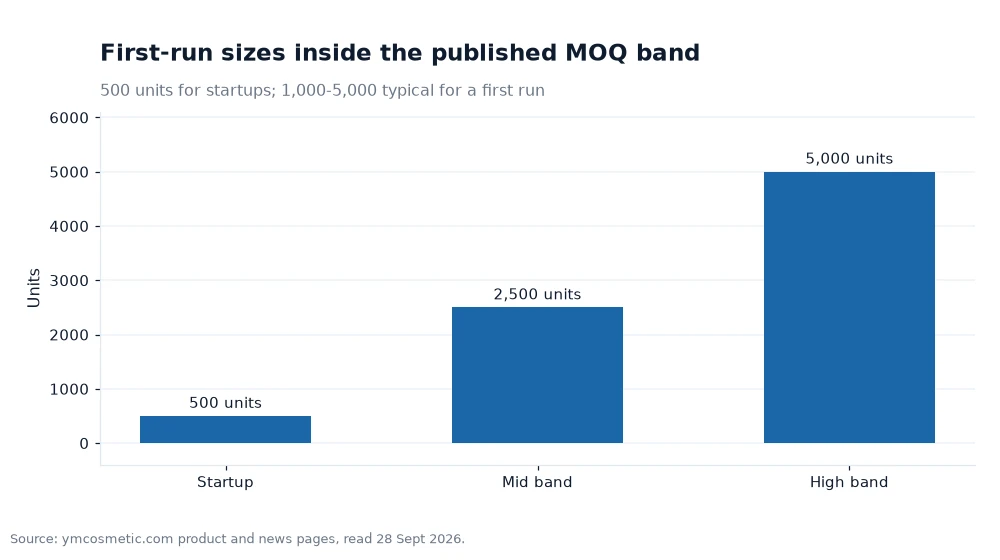
Three bars, one decision. The 500-unit trial is the smallest spend that tests texture and after-feel against real users; the 5,000-unit run carries the lowest unit cost once the formula is settled. Most brands end up doing both, in that order, which is exactly what the band allows.
Frequently asked questions
How long should the brief be?
One page is enough if it carries the six decisions: skin target, type, texture, pH and surfactant level, fragrance and first-run size. Length is not the point; unresolved fields are.
What if the first sample misses the brief?
Go back to the field that was least specific. Samples usually miss on after-feel or texture rather than on fragrance, and both trace back to the pH and surfactant wording in the brief rather than to the base itself.
Can the pack be changed after the sample is approved?
It can be changed, but compatibility work is pack-specific, so a new container may mean repeating part of the testing. Decide the pack before the sample round if the launch date matters.
Turning the brief into a project
Six answers, one page, then sampling. The men's facial cleanser range page publishes the four types and five texture formats this brief is built around, and Yunmei's OEM/ODM manufacturing pages set out what happens between a signed brief and a filled pack. A colour line is specified differently again, and the lipstick development page is the place to check the moulding and shade steps.
The cleanser types, texture formats, order band and capacity figures cited above appear on the manufacturer's website ymcosmetic.com, which I read on 28 Sept 2026. My assumptions are the 120 ml pack, the dose figures and the bulk conversions in the worked example.[1].